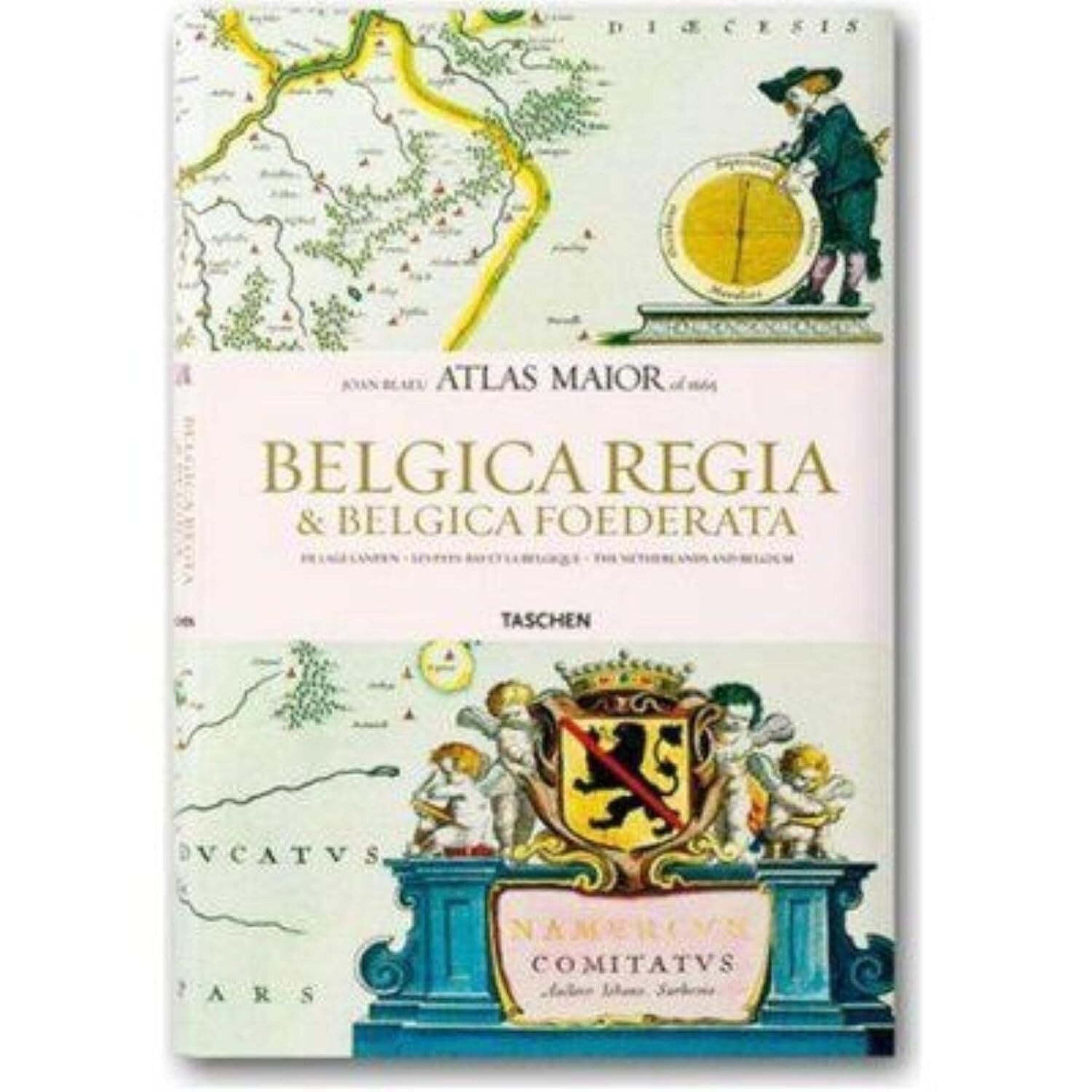
Book Description
This book presents a carefully curated selection from Atlas Maior, the monumental world atlas completed in 1665 by the 17th-century master cartographer Joan Blaeu. It brings together all 63 maps of Holland and Belgium, guiding readers into the heart of Baroque cartographic art and the early modern European worldview. Widely regarded as one of the most exquisite and ambitious Baroque world atlases ever produced, Atlas Maior represents not only the maturity of geographical knowledge of its time, but also a cultural achievement that fuses art, science, and political imagination.
The original Atlas Maior was published as an eleven-volume Latin edition containing 594 maps, covering the Arctic, Europe, Africa, Asia, and the Americas. It was the largest and most comprehensive world atlas of the 17th century. Its creation was closely tied to the intense competition within the Dutch cartographic world: in rivaling mapmaker Joanes Janssonius, Blaeu produced an unprecedented work that secured his irreplaceable position in the history of cartography.
The maps included in this volume depict the Low Countries in the mid-17th century, then known as the Republic of the United Netherlands and the Spanish (or Royal) Netherlands. They are invaluable for understanding the historical boundaries, political structures, and geographical perceptions of what are now the Netherlands and Belgium. This reprint is based on the Austrian National Library (Vienna)’s superb copy, distinguished by its hand colouring and gold-heightened details, and has been reproduced to faithfully preserve the fine line work, rich colour layers, and ornamental elements of the originals, ensuring the highest possible visual and historical quality.
In addition to the maps themselves, the book includes original quotations by Blaeu related to the individual maps, accompanied by newly written scholarly commentary by leading cartography historian Peter van der Krogt. His texts offer in-depth insights into the historical background, cultural context, and symbolic meanings of the maps, introducing readers to the intellectual world of early modern cartography. The text is presented in Dutch, French, and English, combining academic depth with international accessibility.
More than a superb facsimile of historical maps, this book provides an essential lens for understanding the formation of early modern European states, territorial imagination, and the development of cartographic art. It is especially suited for readers in art history, historical geography, and cultural studies, as well as collectors and enthusiasts of antique maps and fine bookmaking.
Details
Authors: Peter van der Krogt, Joan Blaeu
Publisher: TASCHEN
Format: Hardcover
Dimensions: 39 × 25 cm
Pages: 207